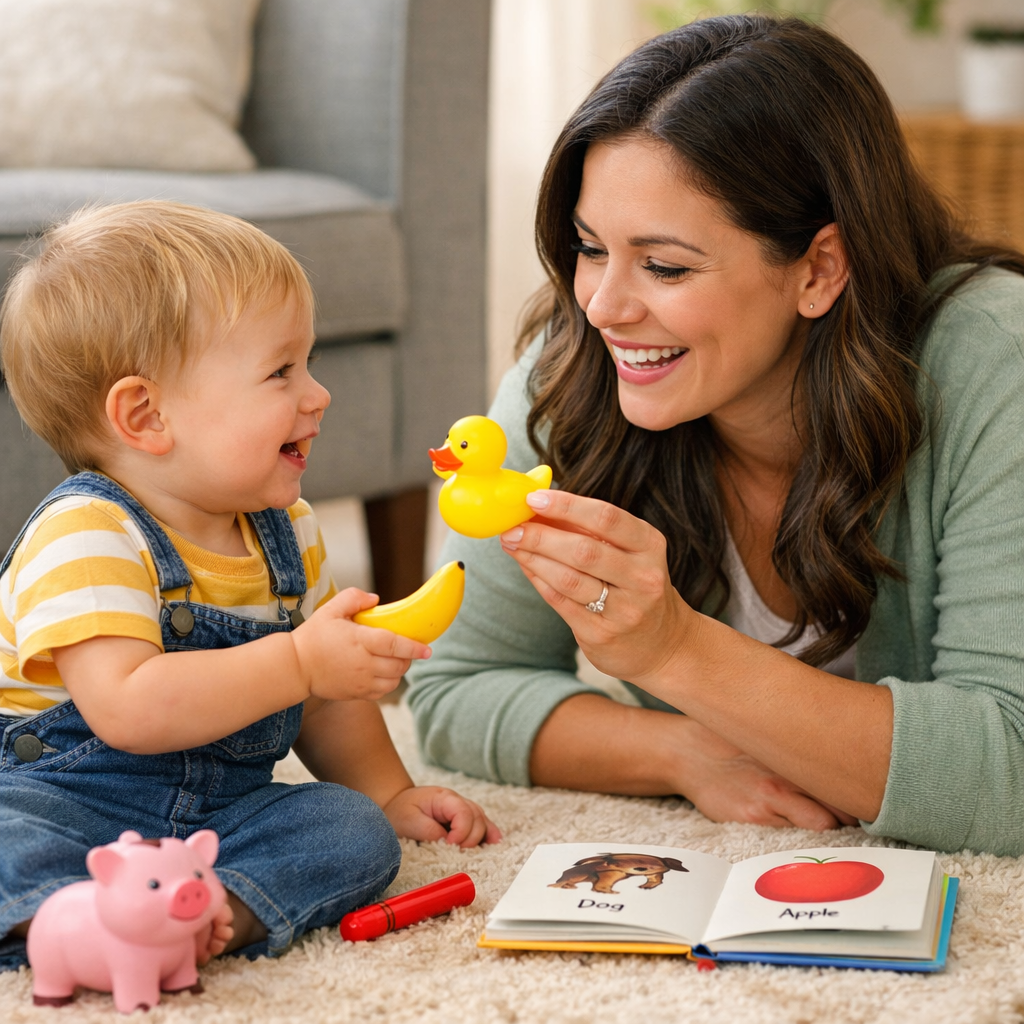
Early Communication Foundations: What Comes Before First Words

The first words typically emerge around 12 months, but spoken words are actually the last step in a long chain of early communication skills. Long before a child says “mama” or “ball,” they must build a foundation of social, cognitive, and motor abilities that make communication possible.
These early skills are called communication prerequisites, and they usually develop between birth and 12 months. If a child is older than 12 months but missing several of these foundational abilities, it’s important to go back and strengthen them first. Words cannot flourish without the groundwork.
-The Core Prerequisites for Communication Before 12 Months:
- Joint Attention - The ability to share attention with an adult by looking back and forth between a person and an object. This is one of the strongest predictors of later language.
- Social Reciprocity - Smiling back, responding to your voice, enjoying face‑to‑face play, and participating in simple back‑and‑forth interactions.
- Imitation Skills - Copying facial expressions, sounds, gestures, and actions with toys.
- Functional Play - Using toys in meaningful ways (rolling a ball, banging blocks, shaking a rattle.
- Cause‑and‑Effect Understanding - Realizing “If I do this… something happens,” such as pressing a button to make a toy light up.
- Intentional Communication - Reaching, pointing, vocalizing, or looking at an adult to get help or share something.
- Sound Play and Babbling - Cooing, squealing, babbling strings like “bababa” or “mamama.”
If these skills are not yet present - even if a child is 15, 18, or 24 months - the focus should shift to building these foundations first. Words grow from connection, imitation, and shared experiences.
-Why These Skills Matter:
Words don’t appear out of nowhere. They require:
- A desire to connect
- An understanding that communication works
- Practice taking turns
- The ability to copy sounds and actions
- Awareness of how objects and people interact
Without these, spoken language has nowhere to “land.”
-Simple Everyday Strategies Parents Can Use:
- Face‑to‑Face Play - Sit close, exaggerate facial expressions, and wait for your child to respond.
- Copy Their Sounds - If they say “ba!”, you say “ba!” right back. This builds imitation and turn‑taking.
- Follow Their Lead - Talk about what they are looking at or doing, not what you want them to do.
- Use Simple Gestures - Wave, clap, blow kisses, and model pointing.
- Play Cause‑and‑Effect Games - Pop‑up toys, rolling balls, knocking down towers.
- Pause More Often - During routines (songs, snacks, play), pause and wait expectantly to encourage your child to take a turn.
- Narrate Daily Life - Describe what you’re doing in short, simple phrases.
These small, consistent interactions build the foundation for communication long before first words appear.
If You Have Concerns:
If your child is older than 12 months and not yet showing many of these early communication skills, it’s absolutely okay - and extremely helpful - to seek guidance early. A licensed speech‑language pathologist can help determine which foundational skills need strengthening and provide individualized strategies.
Related blogs
More resources you might find helpful